Most alien plants in games are Earth plants with the colour changed: a purple oak, a blue palm. They read as fake for the same reason terrain often does. Nothing about them is an answer to the world they stand in.
Real plants are solutions to physical problems: how to get leaves into light, how to hold them up, how to find water, how to survive the worst season. Change the gravity, the air, the star or the orbit, and the best solutions change with them.
TerraFractal already lets gravity, light and the star set tree height, crown size and leaf colour. This post goes a step further: whole body plans that only make sense on certain worlds. Some are ideas I’ve been jotting down, some came out of working through the physics, and several are borrowed from Earth’s seaweeds, which solved floating and holding themselves up long before land plants existed. Each one has a design sketch.
They’re grouped by the combination of world factors that would favour them, because that’s how a generator has to think about them: not “this is a desert plant” but “this is what happens when the air is thick and the star is dim.”
A few numbers that decide a lot
- Thick air holds things up; gravity doesn’t matter as much as you’d think. A gas sac lifts by the difference between its gas and the air around it, and both lift and weight scale with gravity. So balloon plants depend on how dense the air is, not on how strong gravity is.
- Stretched orbits make short, brutal summers. At an eccentricity of 0.4, sunlight at closest approach is 5.4 times what it is at the far end, and the planet spends only a quarter of its year on the near half.
- Thin air means big day-night swings. How cold a night gets depends on how long it lasts compared with how fast the air loses heat, and thin air or strong gravity both make it lose heat faster.
- Thick air pushes hard. A 10 m/s wind at 5 bar pushes like a 22 m/s wind on Earth, so even mild winds favour flexible, streamlined plants.
Dim light and thick air
Think of a red dwarf star, or a world far from its sun, with an atmosphere several times as dense as ours. The problem is getting leaves into enough light. The opportunity is that thick air can hold things up and carry signals a long way.
Balloon lifters
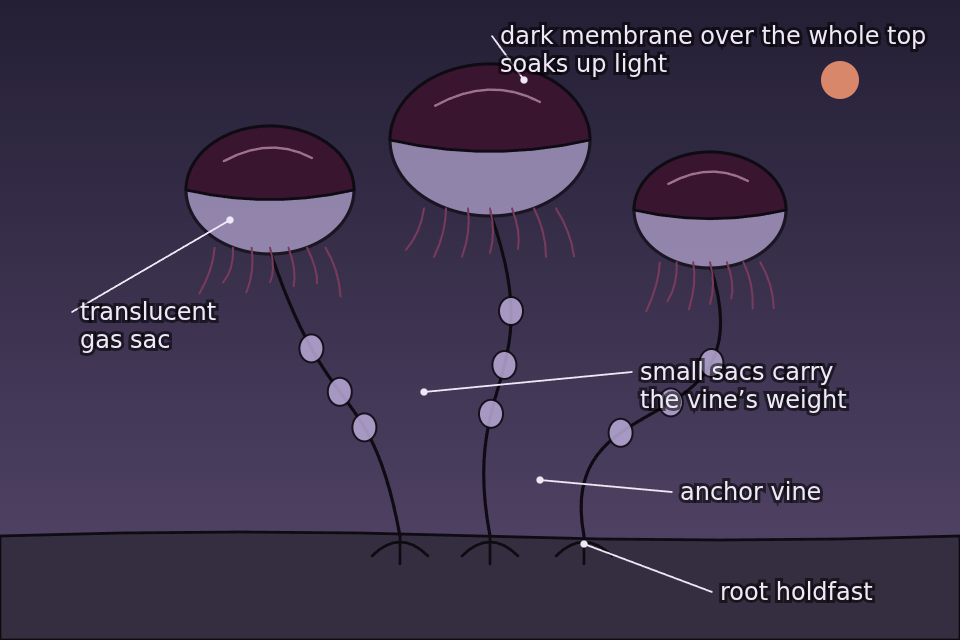
Each plant fills sacs with a light gas from its own metabolism and floats them high above everything else. The whole upper surface of each sac is a dark membrane that soaks up light, so the sac is the leaf: every square metre it lifts is also a square metre catching sunlight, with no separate leaves to carry. Long anchor vines tie the sacs to a root holdfast and carry water up and sugar down, and in the bigger species the vines carry small sacs of their own along their length, so their weight doesn’t drag the canopy down. Picture a field of globes, dark on top and pale beneath, on beaded tethers, all leaning and bobbing together downwind.
Singing bells
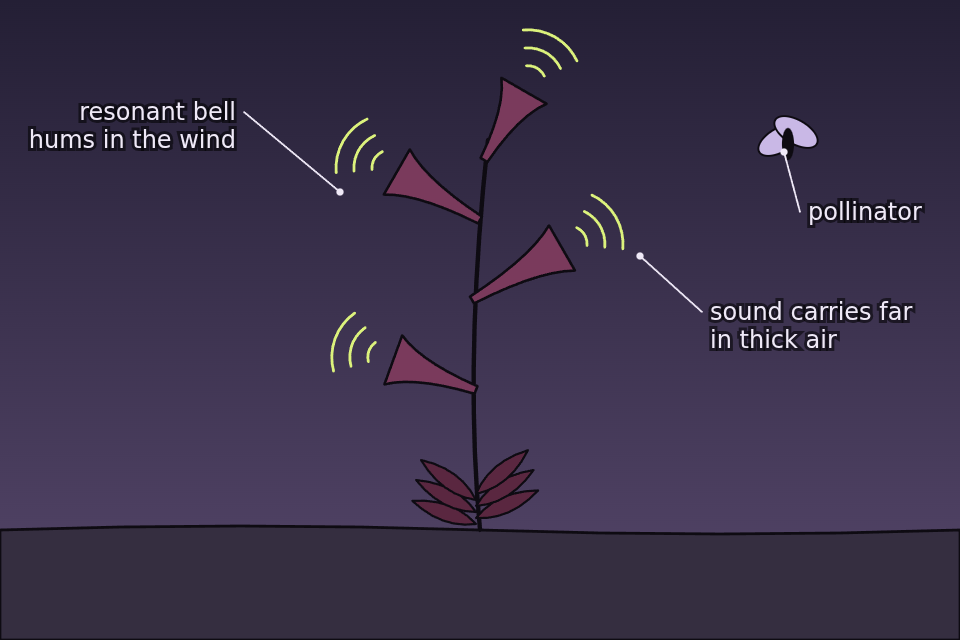
Where light is too dim for colour to work as a signal, a flower can call with sound. Stiff, flared bells hum in the wind or are vibrated by the plant, each species on its own note so its pollinators aren’t confused. Thick air carries sound further, so the calls reach a long way.
Reed pipes
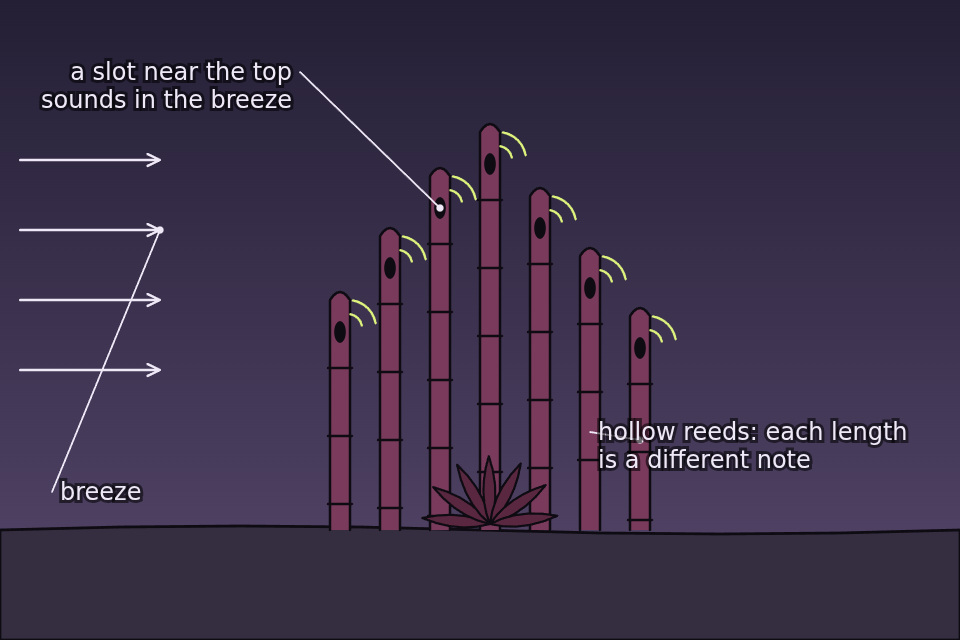
A quieter relative of the bells: a clump of hollow reeds, each a tuned cavity like an organ pipe. A slot near the top makes the air inside sound when the breeze blows across it, and each reed’s length sets its note, so a clump plays a chord that is the species’ own. The plant spends no energy on it; the wind does the work, and a breezy valley full of them is a landmark you could find by ear.
Glowlamps
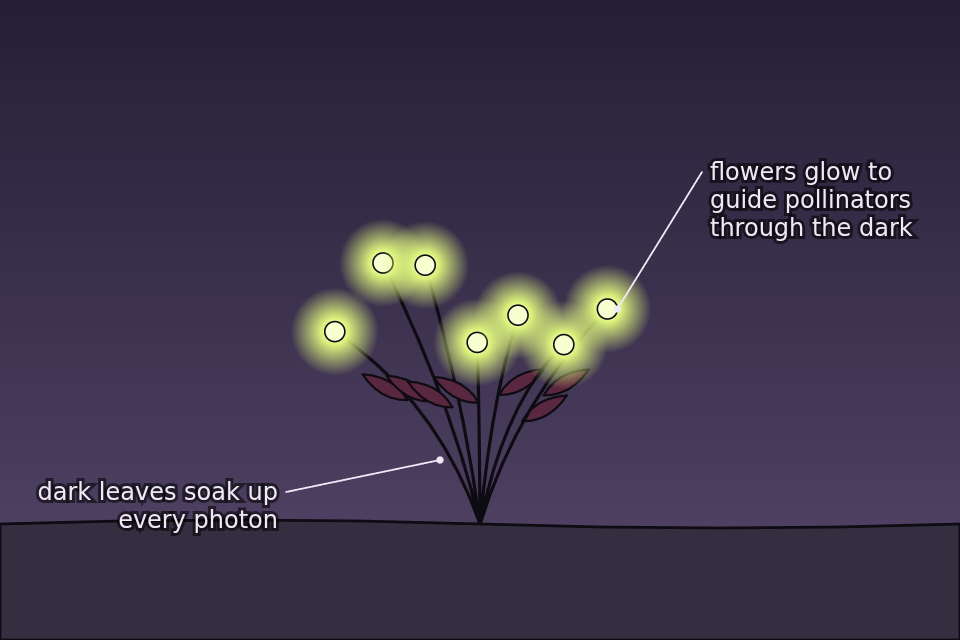
Flowers and fruit glow to guide pollinators and seed carriers through the gloom, while the leaves stay nearly black to absorb all the light they can. On a dim world the glow is often the brightest thing in the landscape.
Air kelp
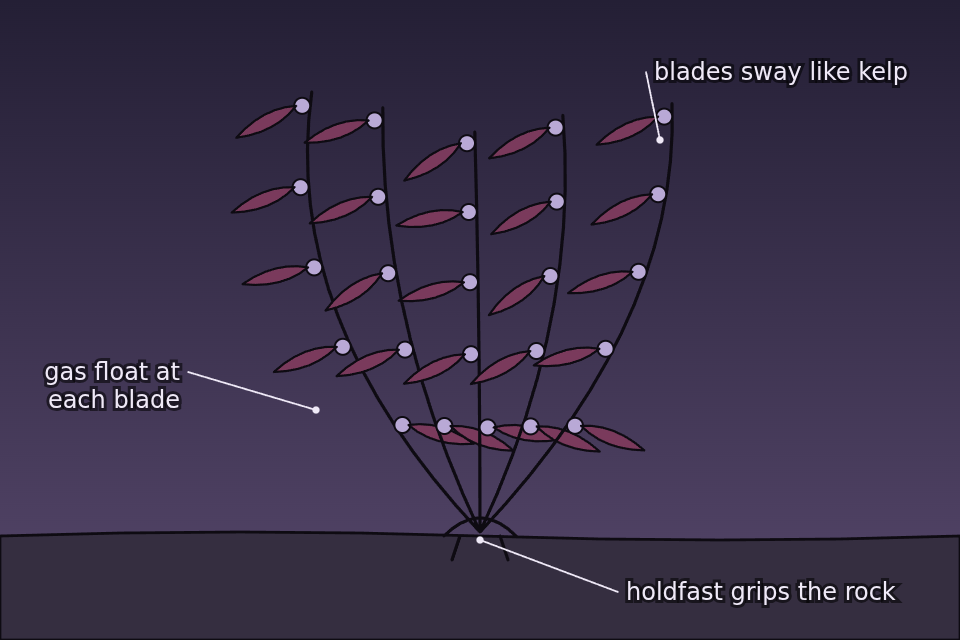
No wood at all. A holdfast grips the rock, and each blade carries a small gas float at its base, so the fronds rise and sway in the dense air the way giant kelp does in the sea.
Drift motes
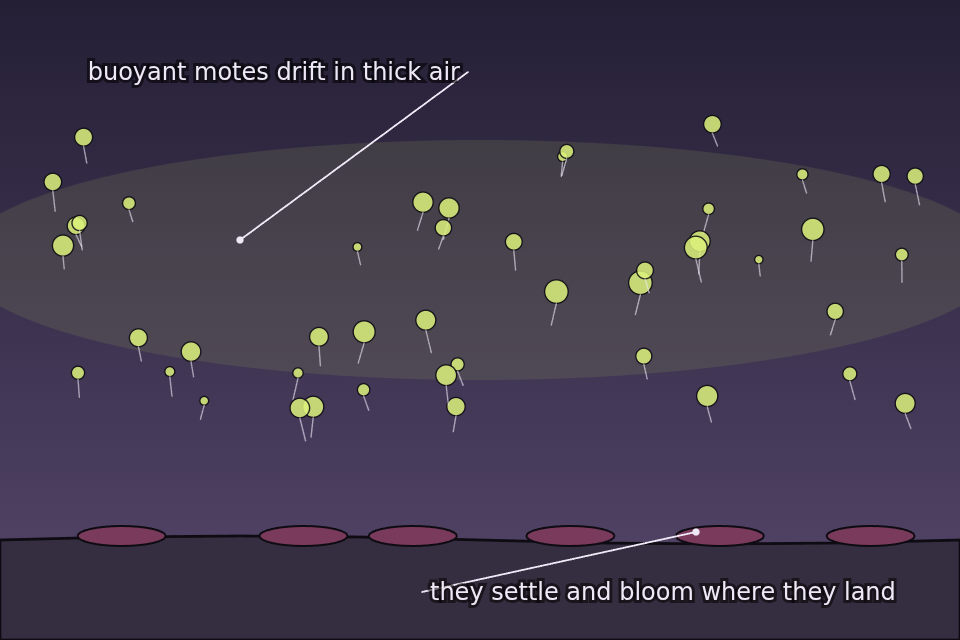
Tiny photosynthetic cells drift in the lower air like plankton in the sea, and settle into coloured mats in damp hollows. A catch I found when I ran the numbers: thick air alone doesn’t keep particles up, because air viscosity hardly changes with pressure. The cells need gas vesicles of their own, or low gravity, or rising air.
For implementers: when this group switches on
- Air density above about 3 kg/m³ (2.5 bar or more at mild temperatures) opens the balloon and air-kelp habits. Whether a gas sac can lift leaves depends on air density, not gravity, because lift and weight both scale with g.
- At 1 bar a hydrogen sac needs about 70 litres per square metre of leaf; at 3 bar about 24; at 10 bar about 7. Methane needs roughly twice as much.
- Low surface light (dim star, distant orbit, thick or hazy air) favours glow and sound signals and very dark leaves.
Bright light and thin air
A hot star or a close orbit, under air too thin to filter ultraviolet. Plants have to shield themselves, keep their fluids from boiling off, and ride out big swings between day and night.
Window domes
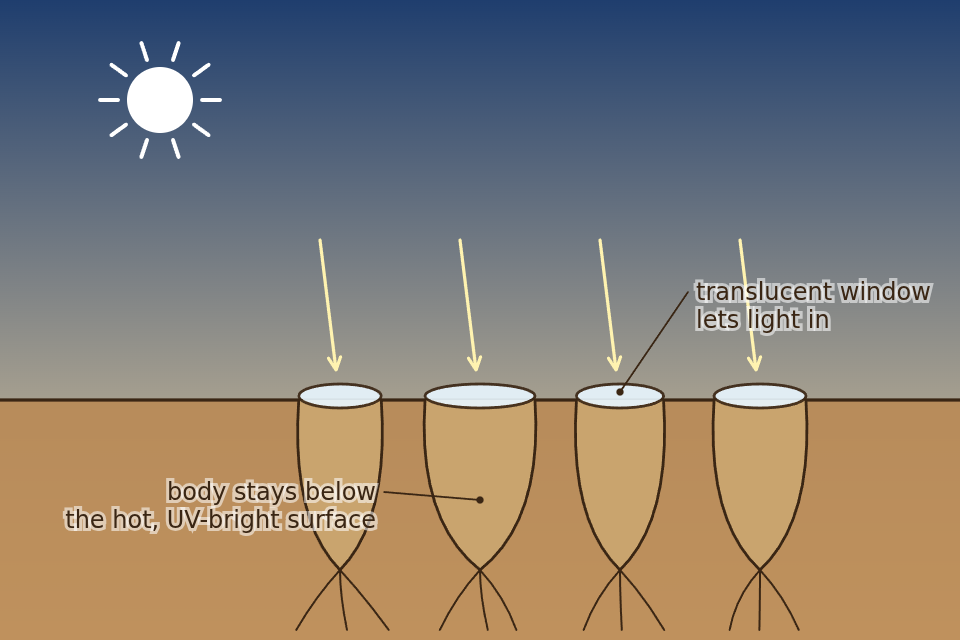
Most of the plant stays underground where it’s cooler and shielded, and only a translucent window at the surface lets filtered light down to the green tissue. A field of them looks like glassy pebbles set into the ground. Earth’s living stones (Lithops) do exactly this.
Pressure barrels
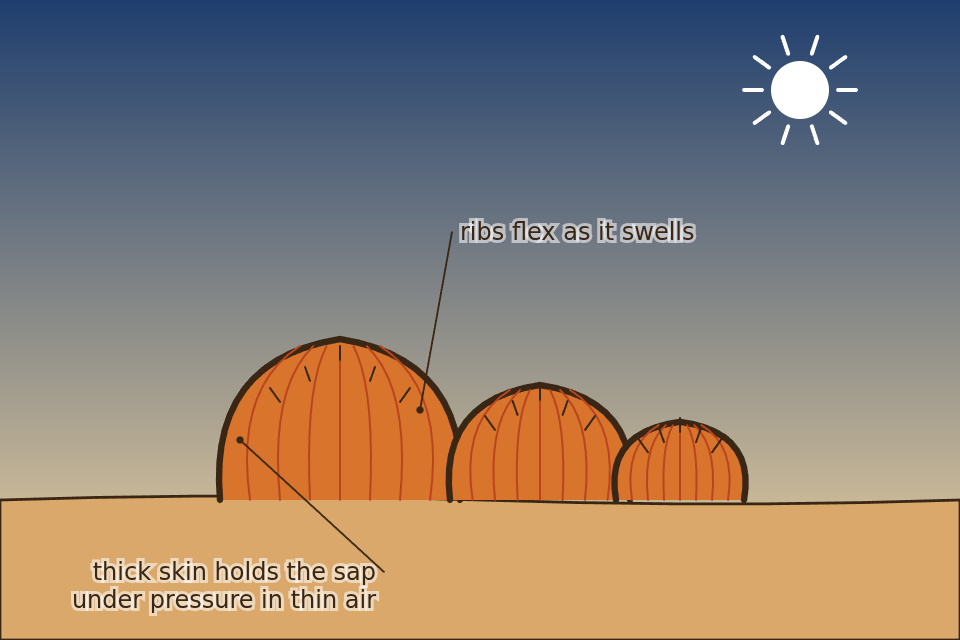
A thick, tough skin keeps the sap under pressure so it doesn’t boil or dry out. The body is round and squat, the least surface for its volume, and ribs let it swell when water comes.
Mirror scales
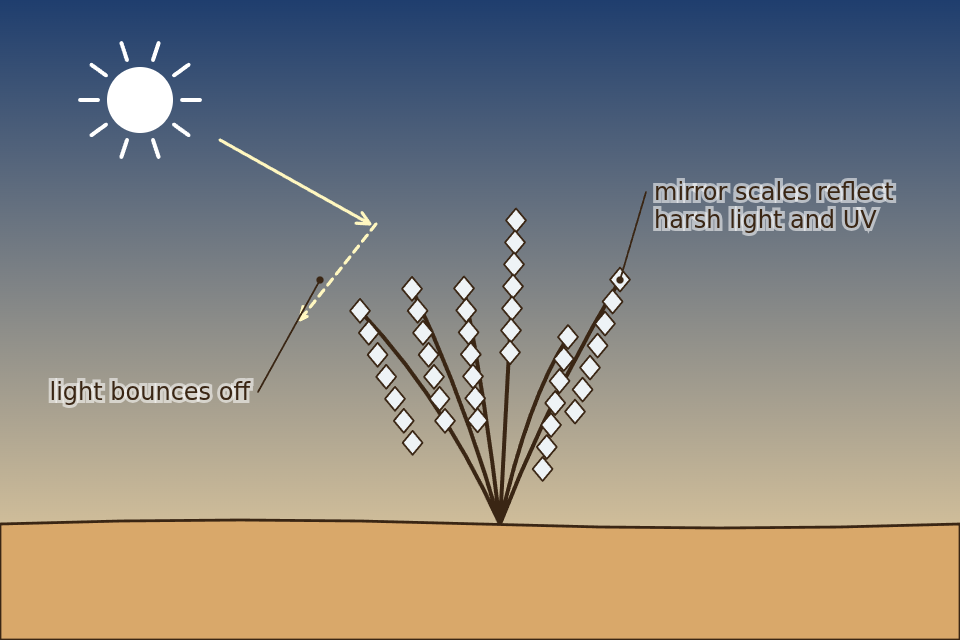
Leaves shrink to scales with a reflective, waxy or crystalline coating. They throw back the harshest light and UV and still pass enough to grow. Whole hillsides glitter.
Stone coral
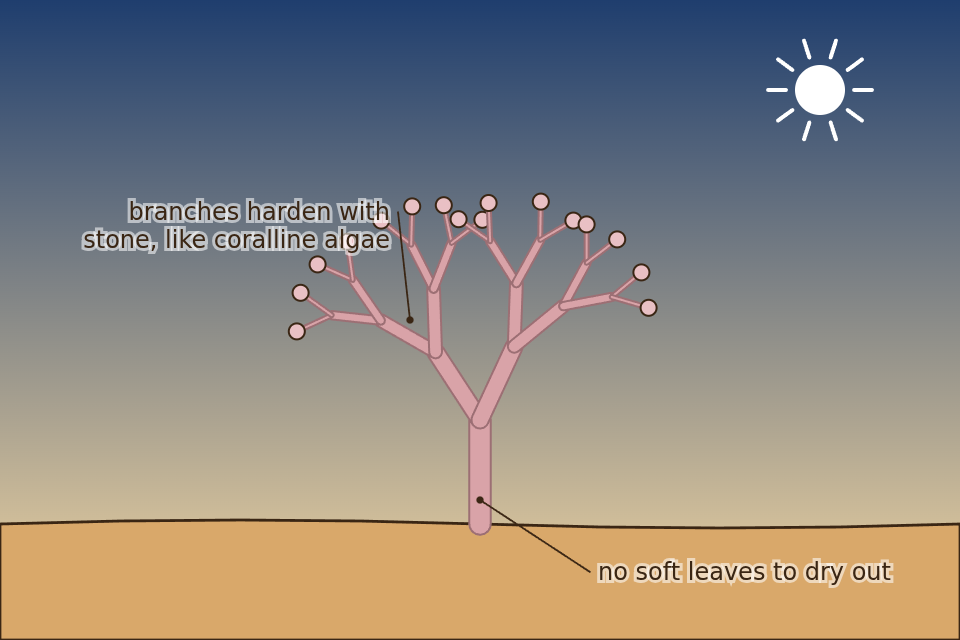
Borrowed from coralline red algae, seaweeds that build stone into their walls. On land the branches are mineral-hardened, with nothing soft to dry out or be eaten. They look like coral reefs stranded on dry ground.
For implementers: when this group switches on
- Low pressure (below about 0.3 bar), hot stars and oxygen-poor air (no ozone) raise surface UV.
- Thin air also means a small air column heat capacity, so days get hot and nights cold, which favours underground and armoured habits.
Low gravity
On a small planet, wood is cheap. The tallest a tree can grow before it buckles goes up as gravity goes down (roughly g to the power -2/3), so plants get tall, thin and delicate.
Lace spires
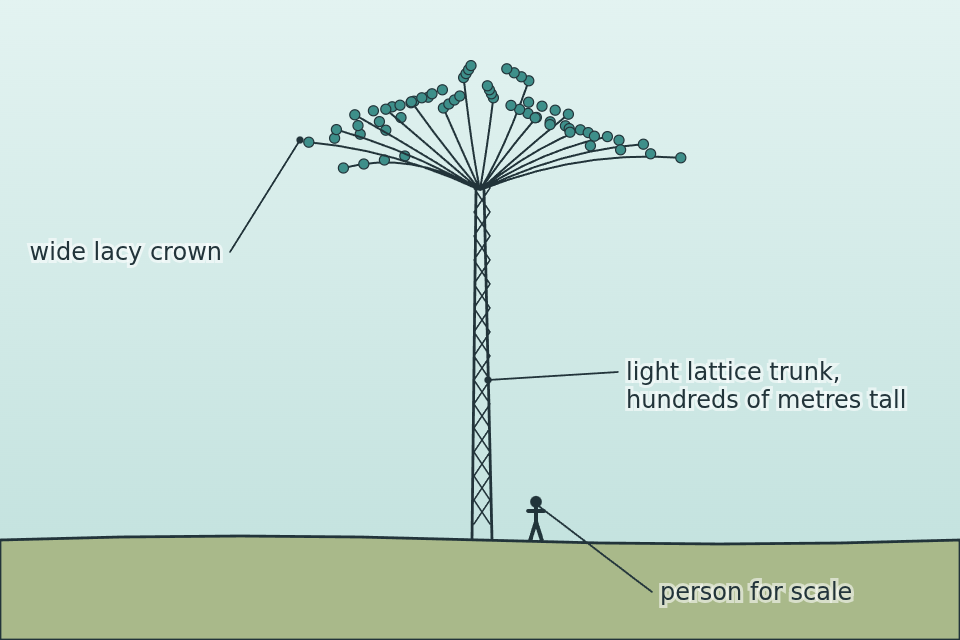
Lattice trunks hundreds of metres tall carry wide, open crowns above everything else. On Earth this would snap in the first storm; at a third of our gravity, with calm winds, it stands.
Catapult pods
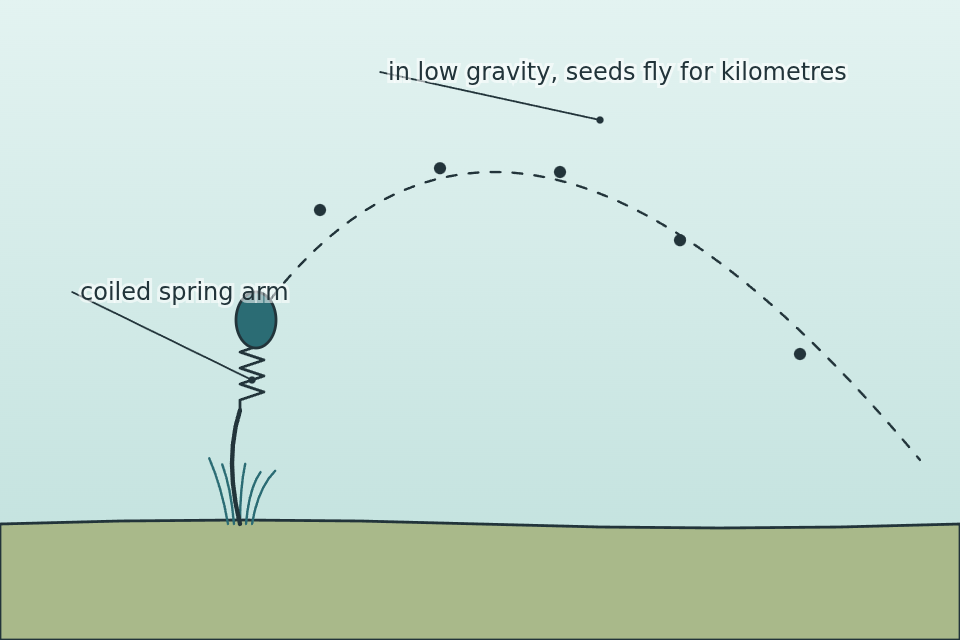
Spring-loaded arms or bursting pods fling seeds. The same energy that throws a seed a few metres on Earth sends it many times further here, so a single plant can seed a whole valley.
Whip floats
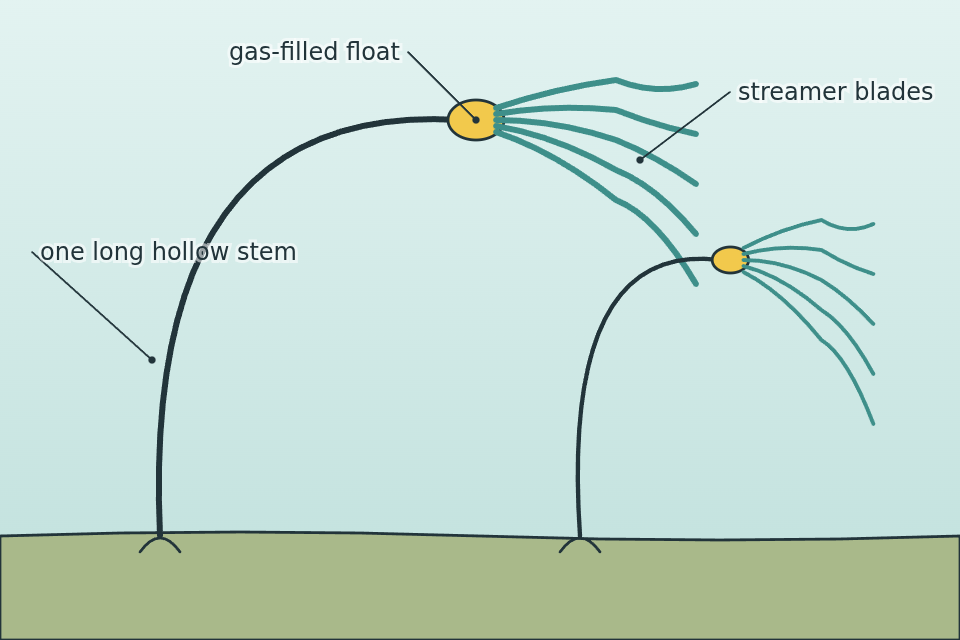
One long, hollow stem with a gas float at the tip holds a tuft of streamer blades high in the air. Bull kelp grows a stem like this tens of metres long in the sea.
Siphon giants
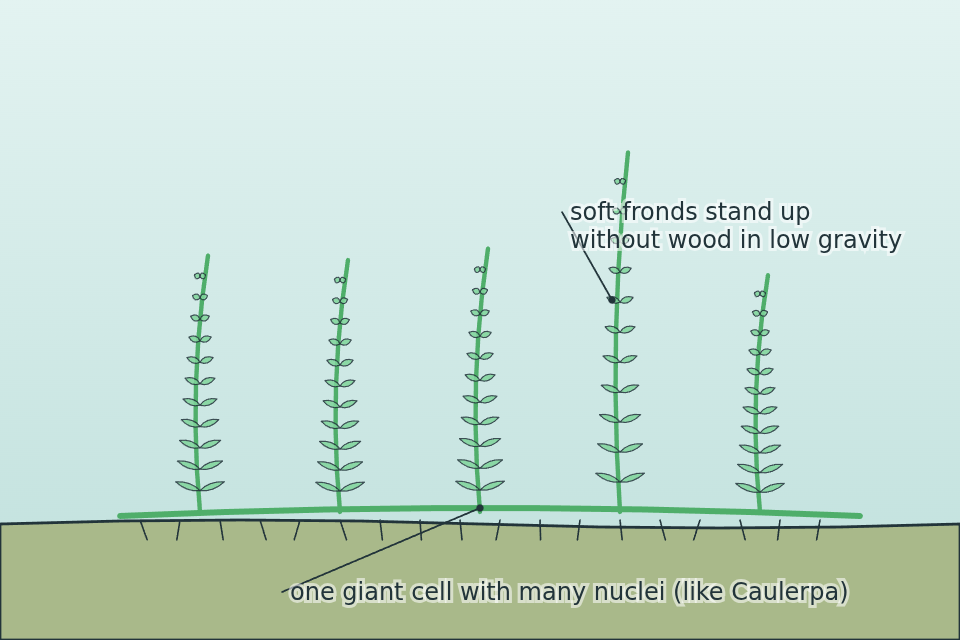
The whole plant is one enormous cell with many nuclei and no internal walls, held up by internal pressure. That only works where gravity is weak and the air stays damp. The seaweed Caulerpa does this in the sea.
For implementers: when this group switches on
- Gravity below about 0.6 g. Calm winds matter as much as gravity for the tallest forms.
- Thick air on top of low gravity makes many of the dim-light habits easier too.
High gravity
On a heavy world, height is expensive and falling over is fatal. At the same surface pressure the air column is also lighter, so temperature swings are larger.
Carpet forests
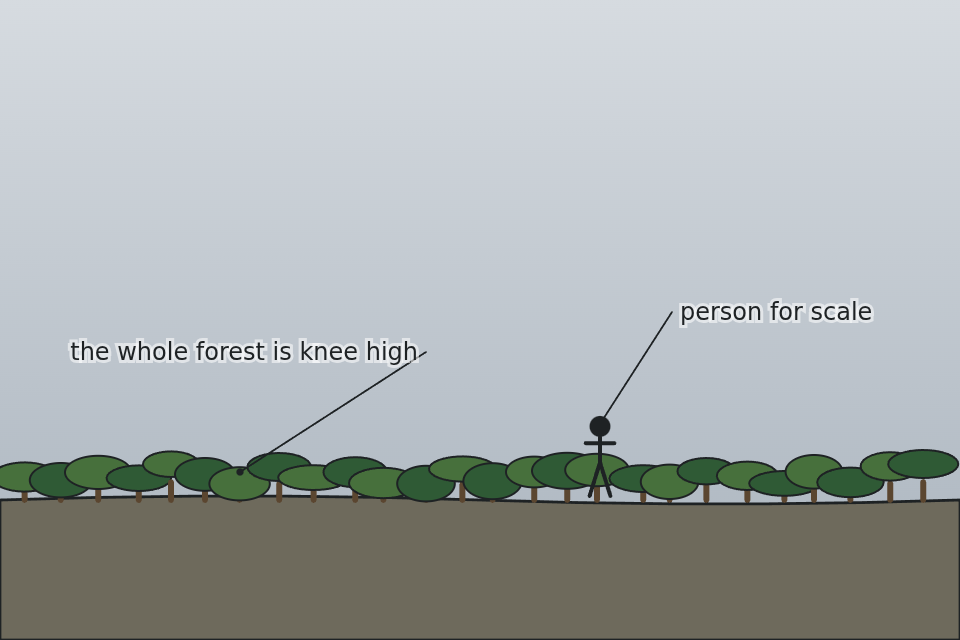
The race for light happens close to the ground. Many low, layered crowns form a dense mat that a person could wade through.
Buttress tubes
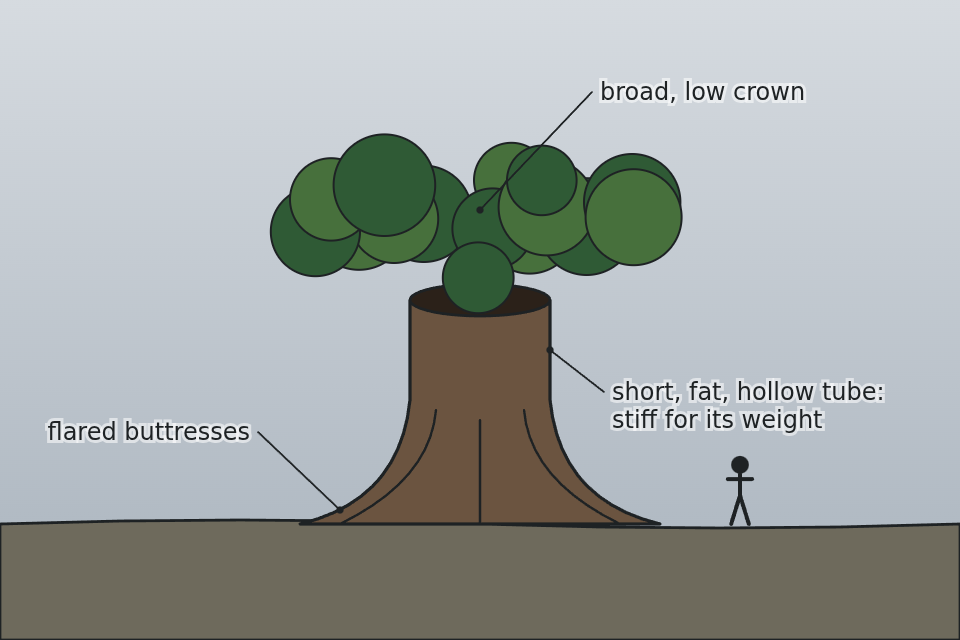
For the rare tall plants, a hollow tube is the stiffest shape for its weight. Short, fat trunks flare into buttresses and carry broad, flat crowns.
Walking layerers
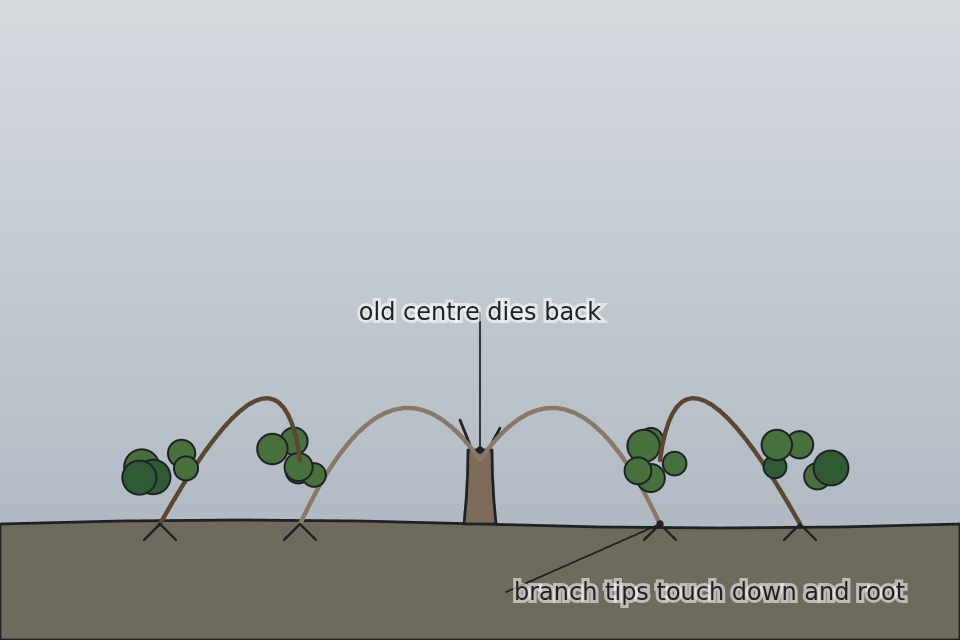
Branches arch over and root where they touch the ground, the old centre dies, and the plant walks outward as a ring of arches.
Crust sheets
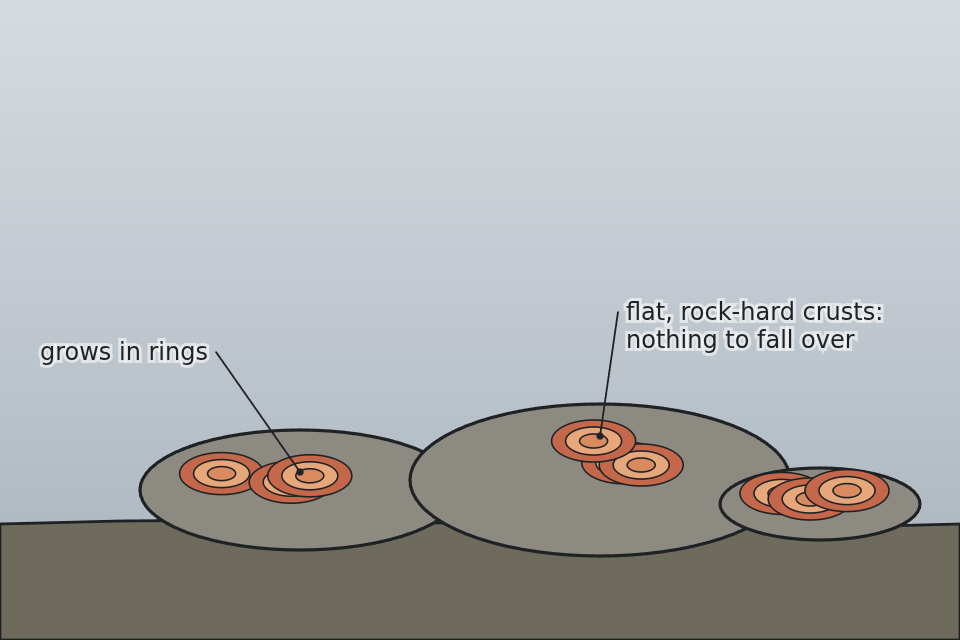
Flat crusts grow over stones in coloured rings, like encrusting coralline algae or crustose lichen. There is nothing upright to fall over.
For implementers: when this group switches on
- Gravity above about 1.5 g. Tree heights already scale down with gravity in TerraFractal; these add the body plans that go with it.
Hot and dry
Water is the whole game. Some plants make dew, some comb fog out of the air, some share water, and some simply wait.
Dew cups
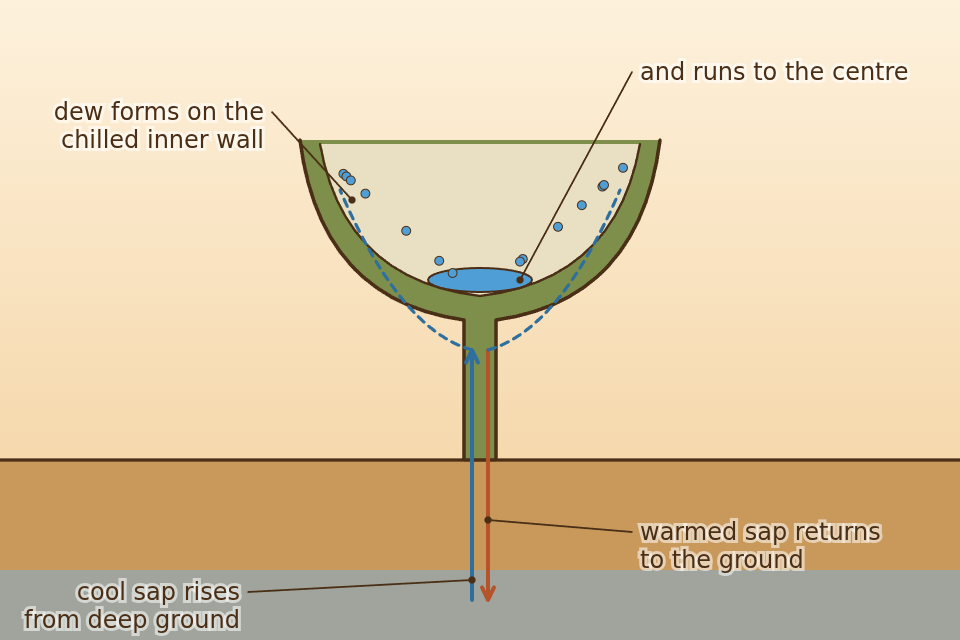
Sap is pumped up from cool ground a metre or more down into the walls of a large cup, chilling the inner surface below the dew point. Dew forms on the wall, runs to a reservoir in the centre and down to the roots, and the warmed sap sinks back to cool. When I checked the physics, this works best where humid air meets cooler ground: fog coasts, humid nights, or slow-turning worlds where the deep ground holds the long night’s cold.
Fog harps
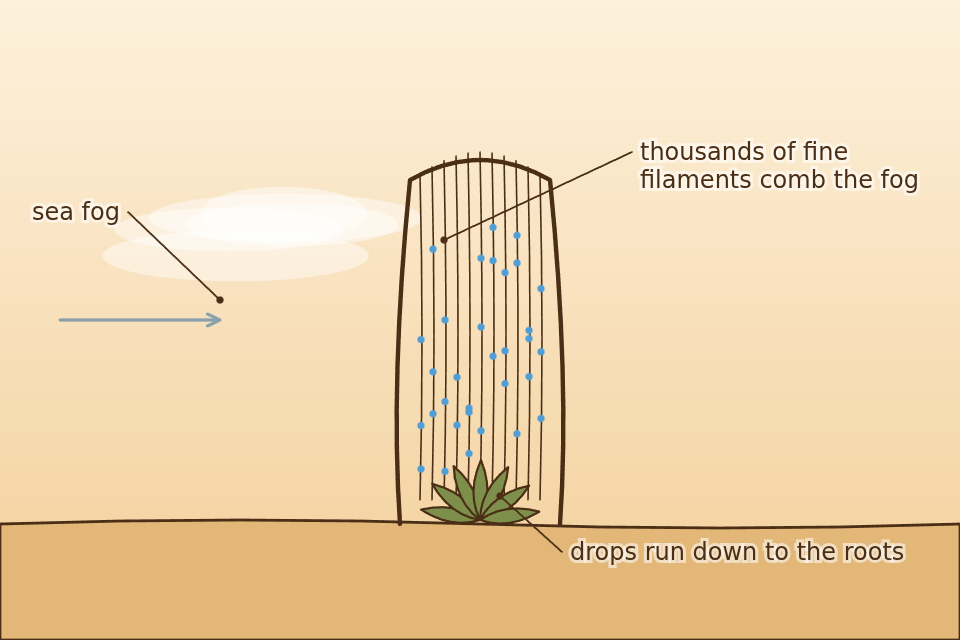
A frame strung with fine filaments stands across the fog wind. Droplets hit the threads, merge and run down to the roots. Every harp faces the same way, so they double as a compass.
Water banks
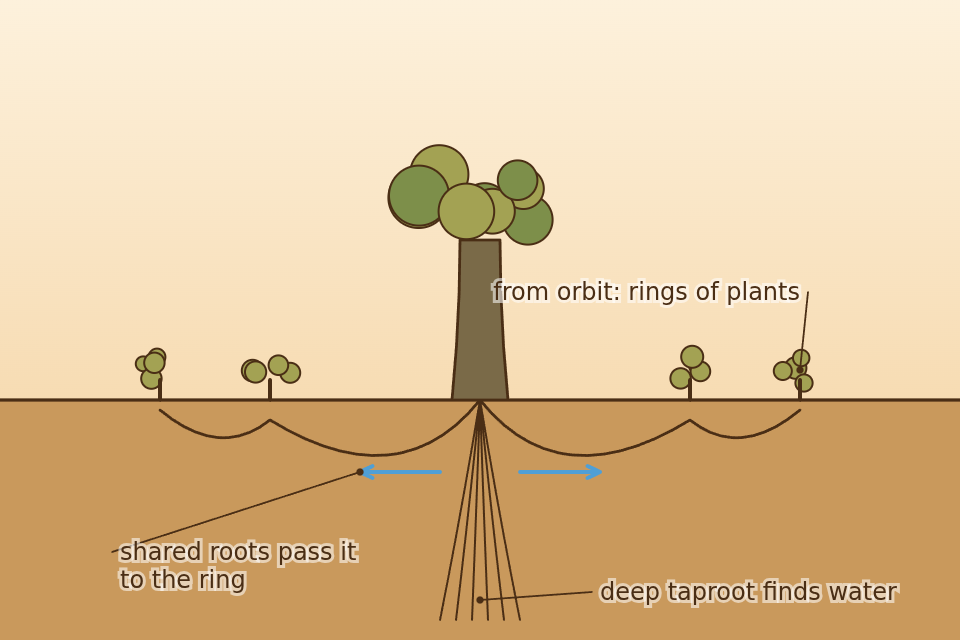
A deep-rooted plant reaches the water table and passes water along shared roots to a ring of smaller plants that shade and feed it in return. From orbit, the desert is dotted with rings, a bit like the real fairy circles of the Namib.
Flash bloomers
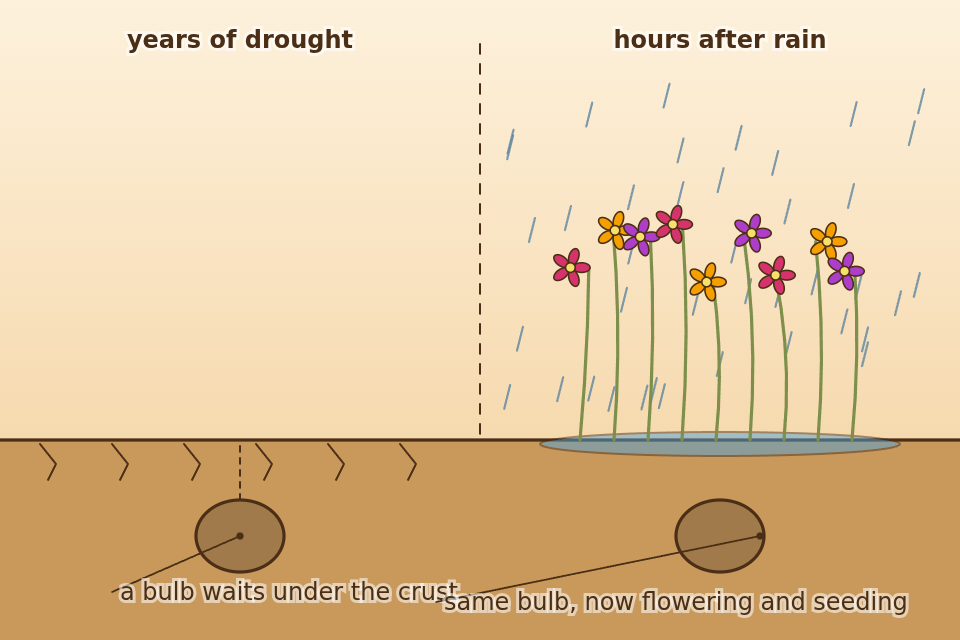
Years as a bulb under the crust, then a whole life in days after a storm. Most of the time you see nothing; after rain, a carpet of colour follows the storm track.
For implementers: when this group switches on
- Dew cups and fog harps belong where the climate model already makes marine stratocumulus: cool sea next to dry land.
- Water banks and flash bloomers belong on dry ground with deep groundwater or rare heavy rain.
Cold
Cold plants need to trap warmth, or find it.
Glasshouse bells
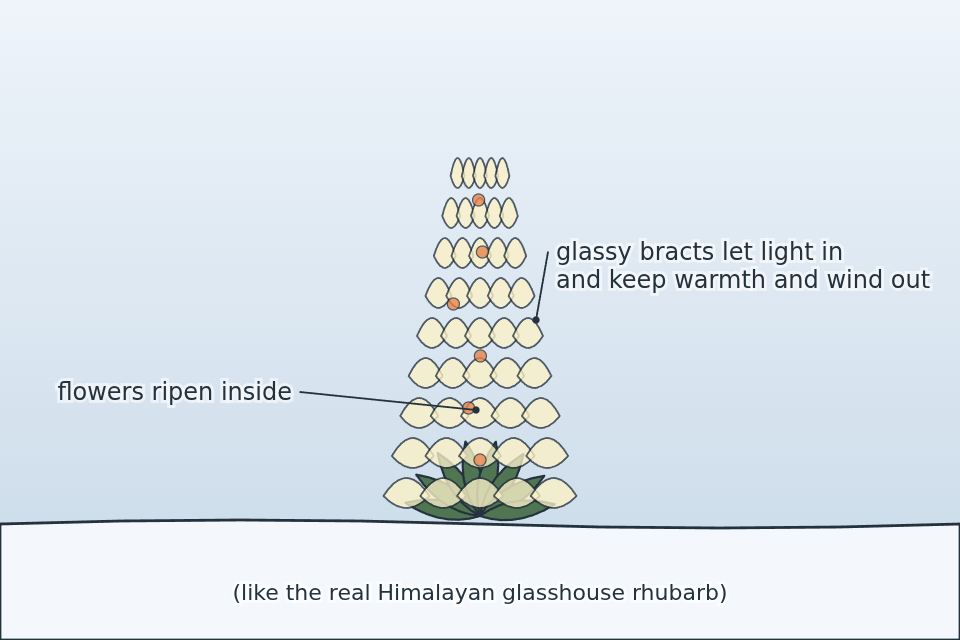
Translucent bracts overlap into a pagoda that lets light in and keeps warmth and wind out, so the flowers ripen inside. A real Himalayan rhubarb does this.
Vent rings
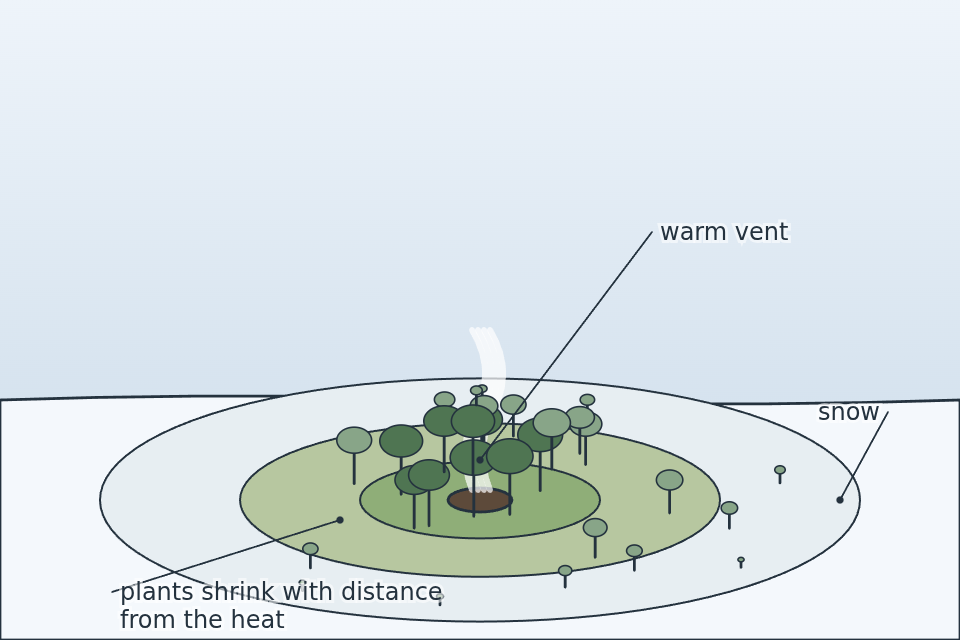
Around geothermal vents in a frozen landscape, plants crowd onto the warm ground, shrinking ring by ring as the ground cools. Some might even live partly on the vent’s chemicals instead of light.
For implementers: when this group switches on
- Vent rings need a ground heat field (hot springs and young volcanic crust), with plant size set by ground temperature rather than air temperature.
Very wet
Flooded ground, constant rain and air that never dries.
Stilt forests
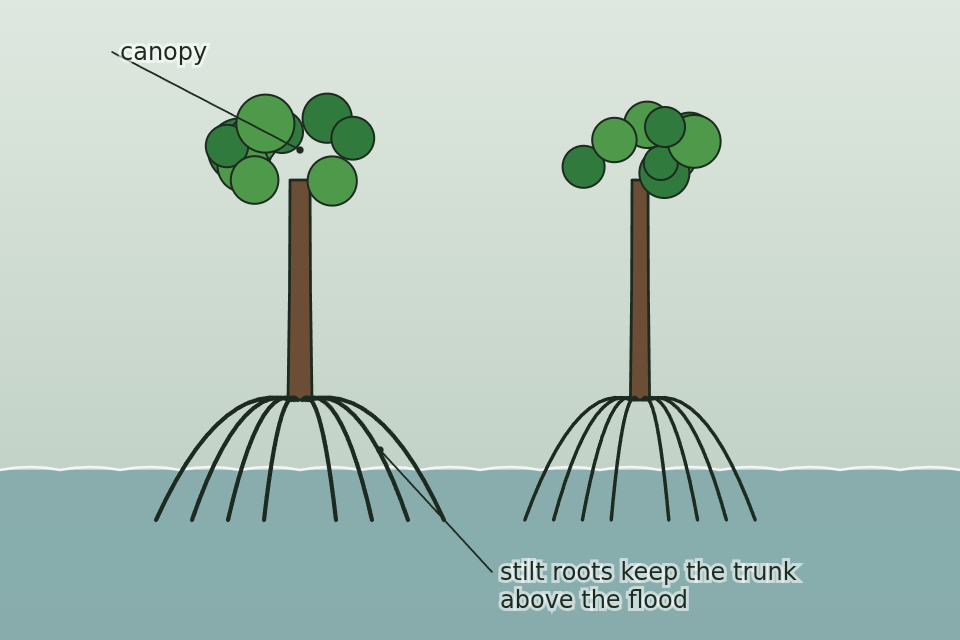
Stilt roots hold the trunk above the water and brace it in soft mud, like mangroves.
Gutter leaves
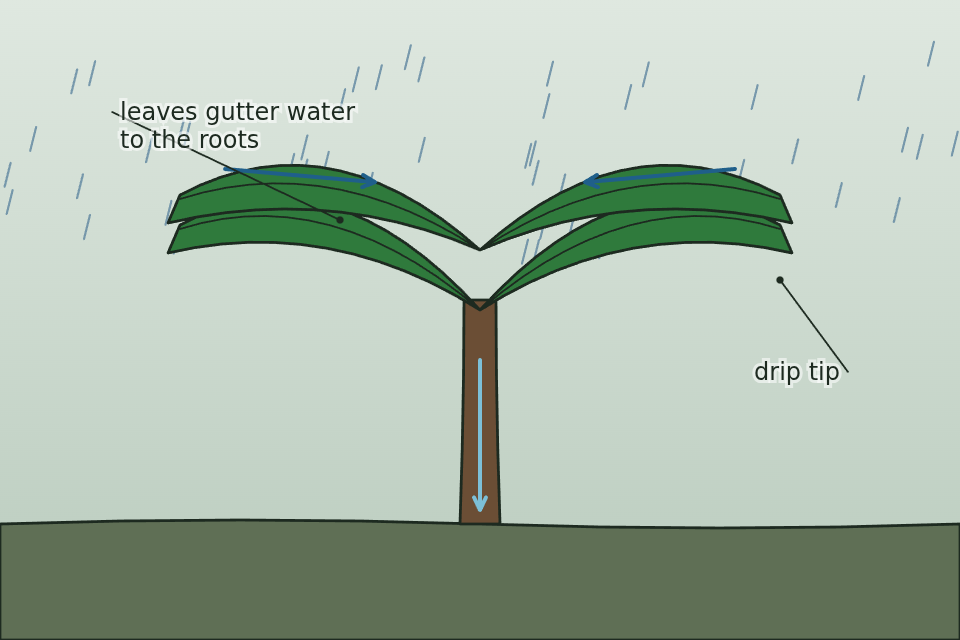
Leaves fold into channels with drip tips. They shed heavy rain before it can rot or break them, and some route it straight to their own roots.
Snorkel roots
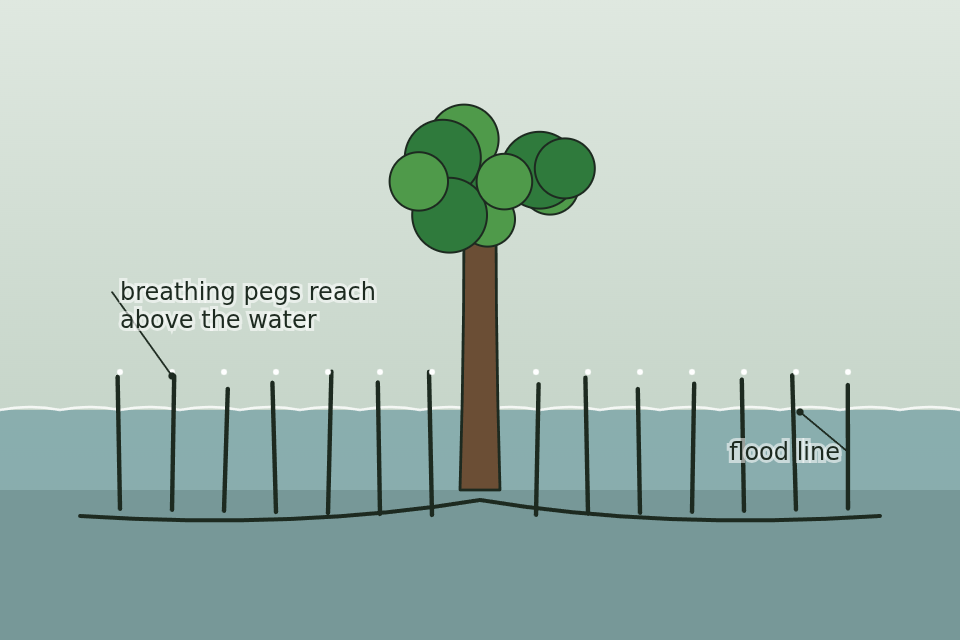
In waterlogged mud with no oxygen, roots send pegs up above the water line to breathe. The tops of the pegs mark the flood line.
Ribbon meadows
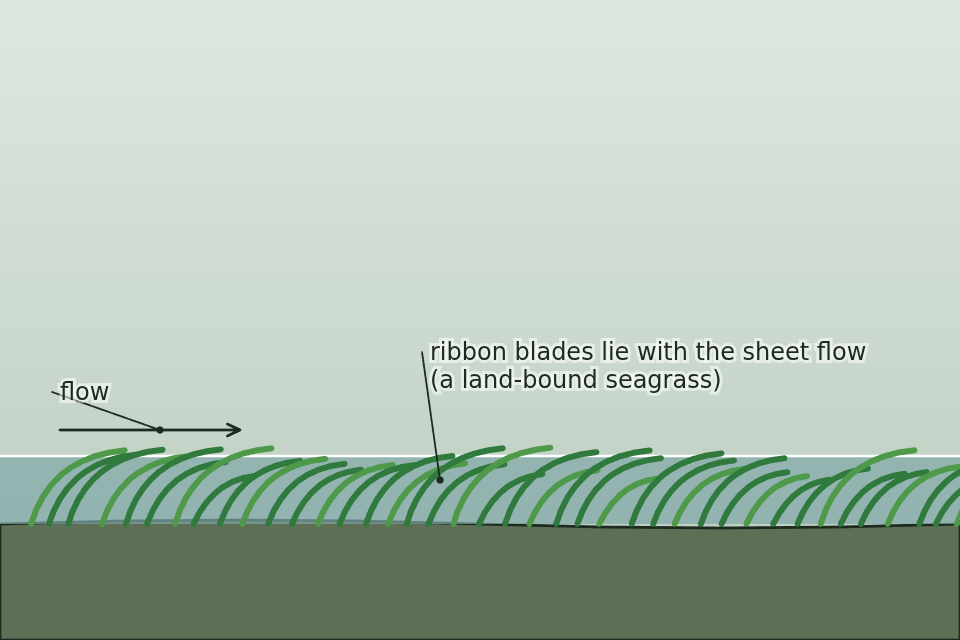
Seagrasses are land plants that went back to the sea. On a world of shallow sheet floods, a seagrass-like meadow could come back out: ribbon blades that lie flat with the flow and stand up when it drains.
Fog sheets
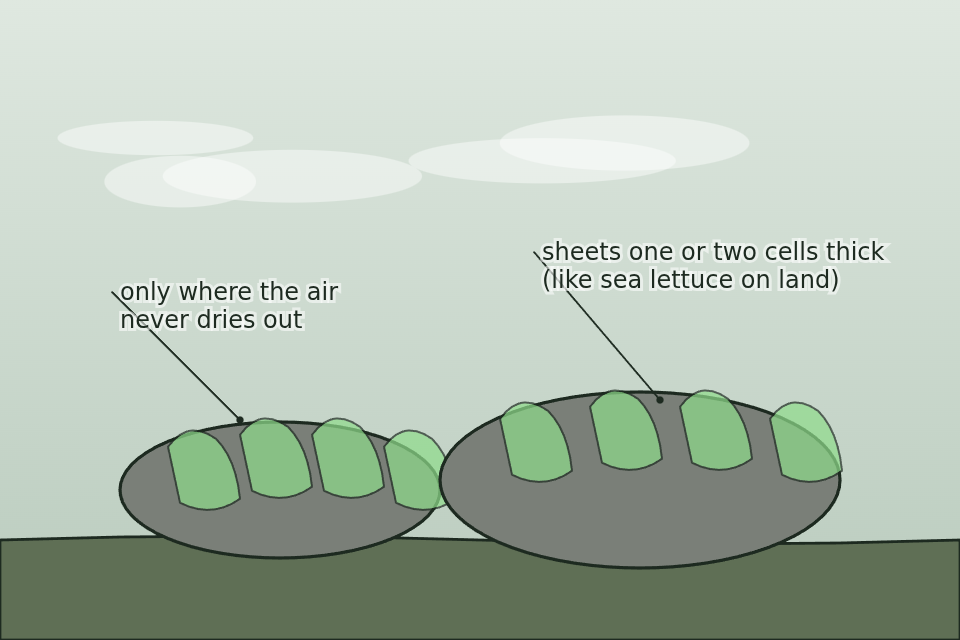
Thin sheets one or two cells thick take water and gas straight from the air. They’d die after one dry day, so they only live where the air never dries out.
For implementers: when this group switches on
- Stilt and snorkel roots follow flood depth and frequency; ribbon meadows follow sheet-flow direction from the drainage field; fog sheets need humidity near saturation.
Ocean worlds
On a planet that is almost all water, life floats. These are some of my favourite ideas because they make the sea itself a landscape.
Drift mats
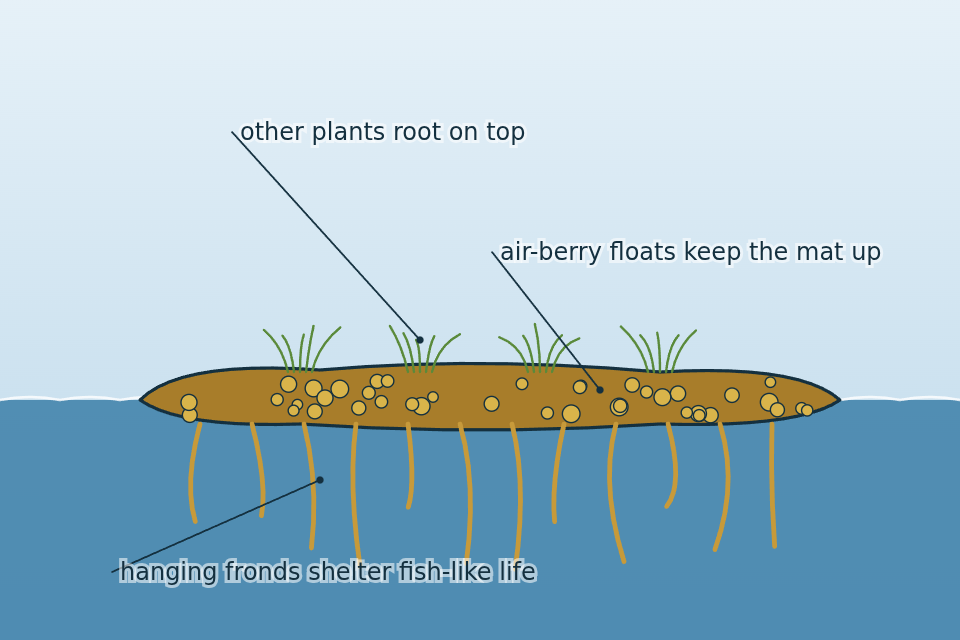
Floating mats held up by air-filled berries carry other plants on top and shelter animals in the fronds hanging below. Currents gather them into belts that can be seen from orbit. Sargassum does this on Earth over hundreds of kilometres.
Sail rafts
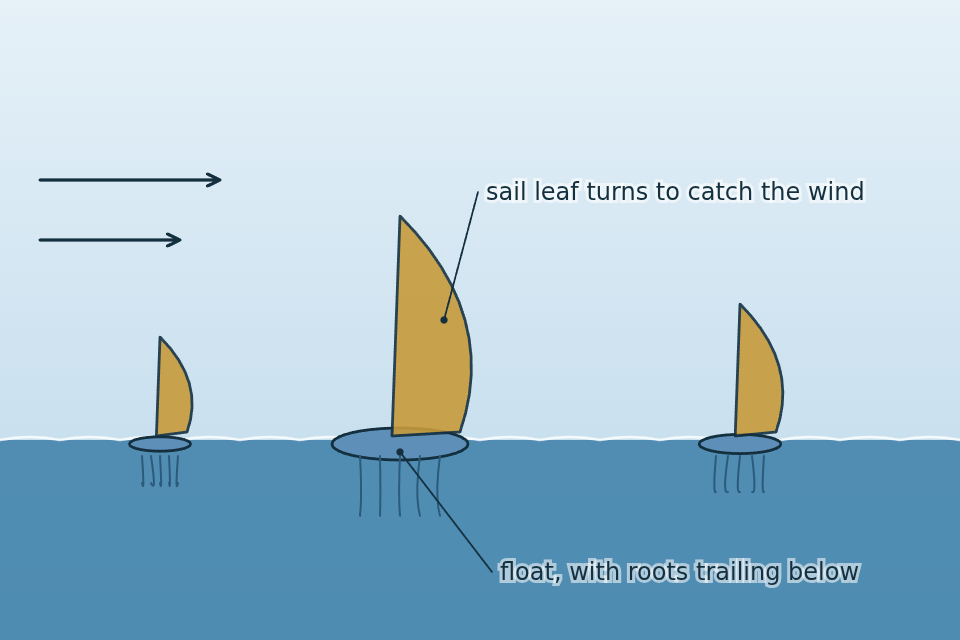
A float with an upright sail leaf that turns to catch the wind, so the plant sails toward warmer or richer water. Whole fleets drift in the same direction.
Rafting forests
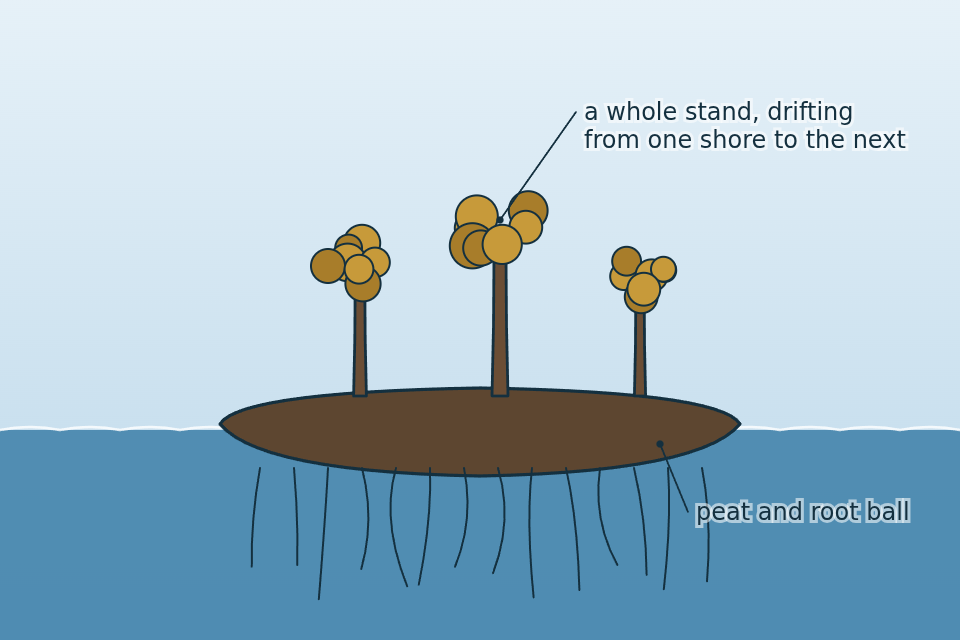
Islands of peat and roots carry whole stands of trees from one shore to the next, spreading species across the ocean.
For implementers: when this group switches on
- Needs a new ocean-surface vegetation layer, placed where ocean currents converge (or by the wind field as a first guess).
Strong tilt and long years
A large axial tilt and a long orbit make seasons both extreme and long. A plant may need two bodies, or to move.
Migrating creepers
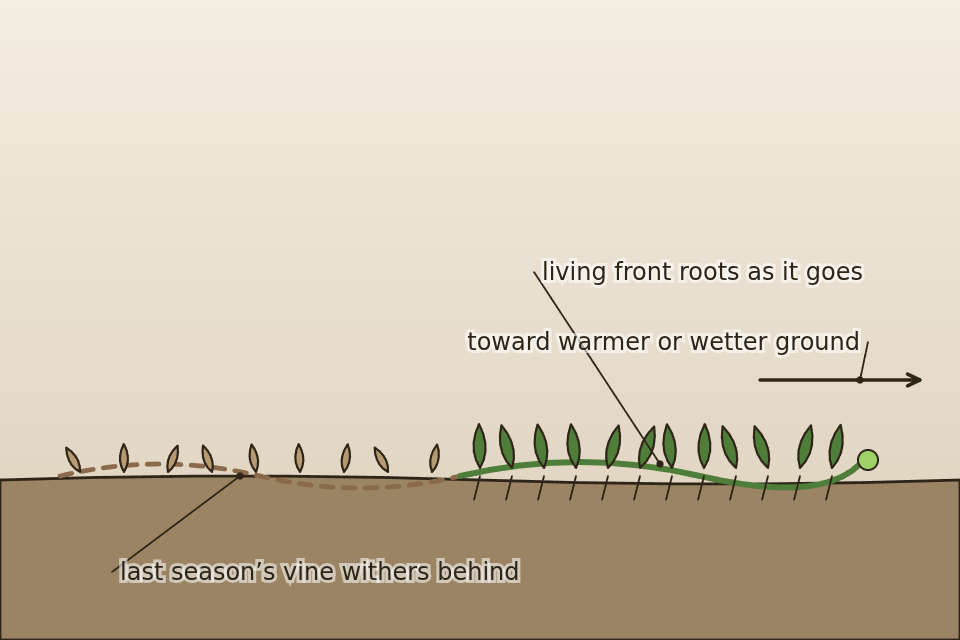
A creeper grows steadily in one direction, rooting as it goes, while the old parts behind it wither. Over a long season it moves toward warmer, wetter or freshly thawed ground, and from orbit the bands shift with the seasons.
Rolling spheres
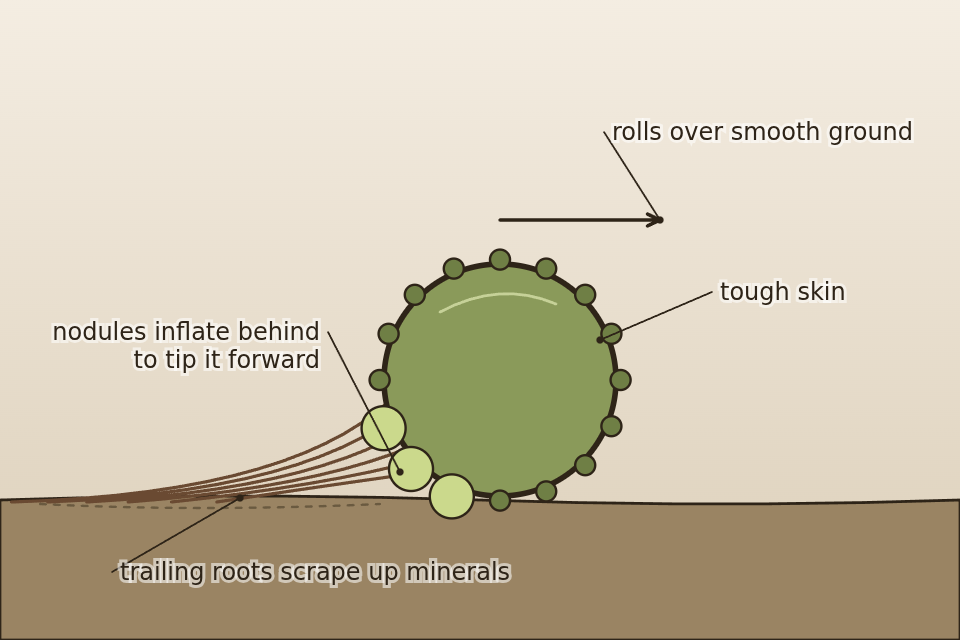
A slower, stranger traveller: a roughly spherical plant with a tough skin covered in nodules it can inflate and deflate one at a time. Pumping up the nodules behind and below tips its balance forward, and it rolls a little; repeat, and it creeps across smooth ground such as salt flats, plains and dry lake beds. Trailing root tentacles drag behind it, scraping up minerals and water, and a faint track marks where it has been.
Retractors
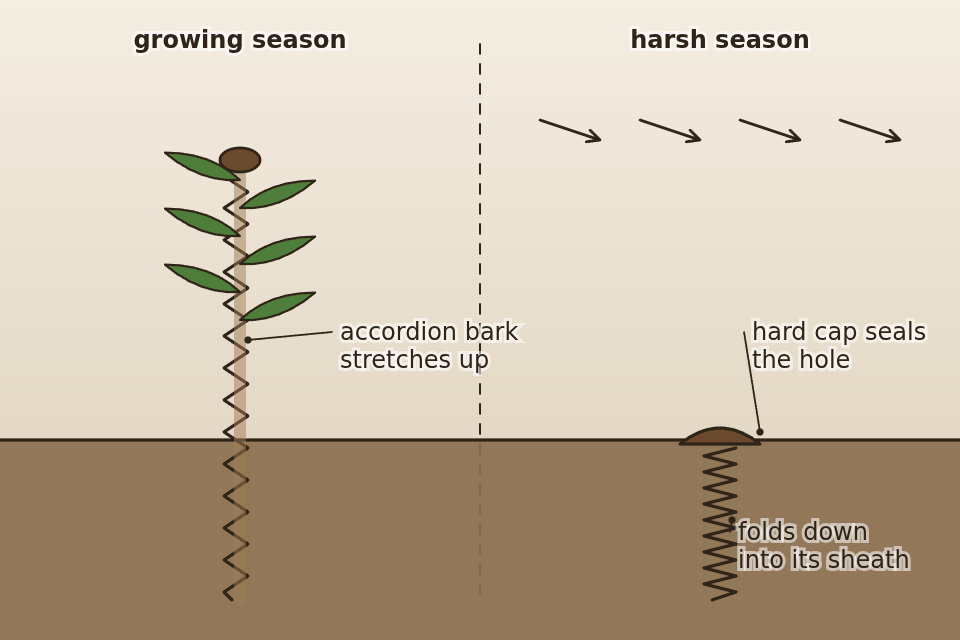
The stem has soft, folding bark like an accordion. In the growing season it extends up out of a sheath in the ground; for the harsh season or a storm it pulls itself down and seals the hole with a hard cap.
Two-form plants
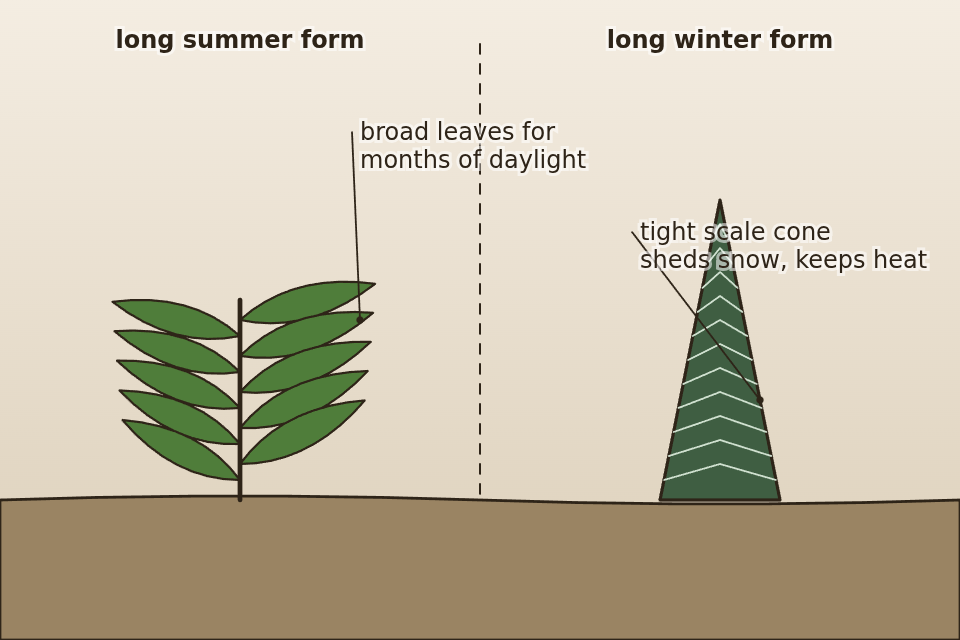
The same plant grows a different body each season: broad, flat leaves for months of daylight, then a tight cone of scales that sheds snow and keeps heat.
For implementers: when this group switches on
- Axial tilt sets how strong the seasons are (above about 54° the poles get more sunlight over a year than the equator); the length of the year sets how long each one lasts.
Eccentric orbits
On a stretched orbit, sunlight at the closest point can be several times what it is at the farthest. At an eccentricity of 0.4 it’s more than five times, and because the planet moves fastest near its star, that scorching summer takes only a quarter of the year.
Sinking umbrellas
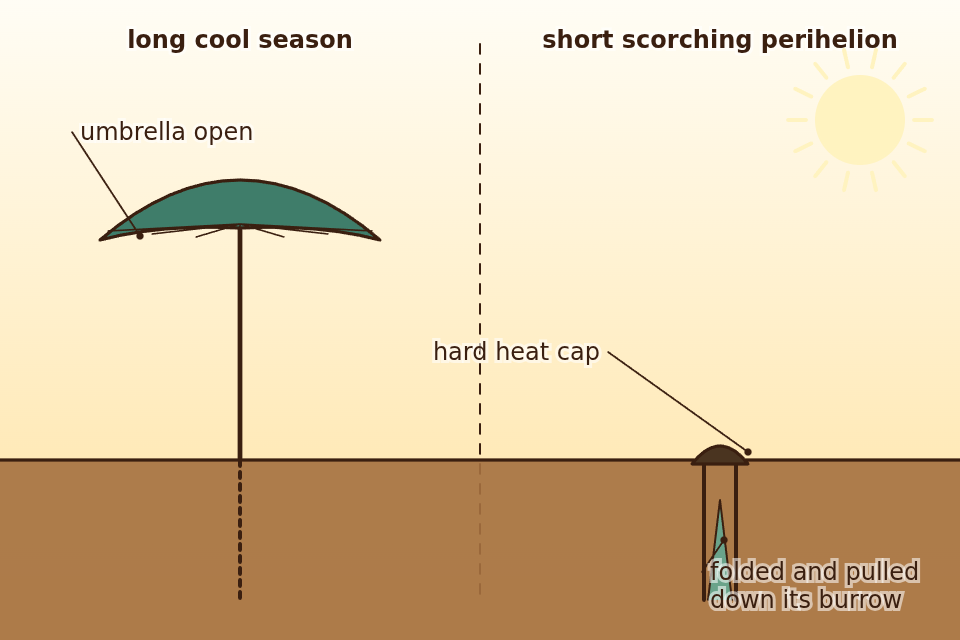
An umbrella of leaves catches light through the long cool season. As the star comes close, it folds like a closed parasol and the plant pulls itself down a burrow, sealing the top with a hard heat cap until the heat passes.
Perihelion sprinters
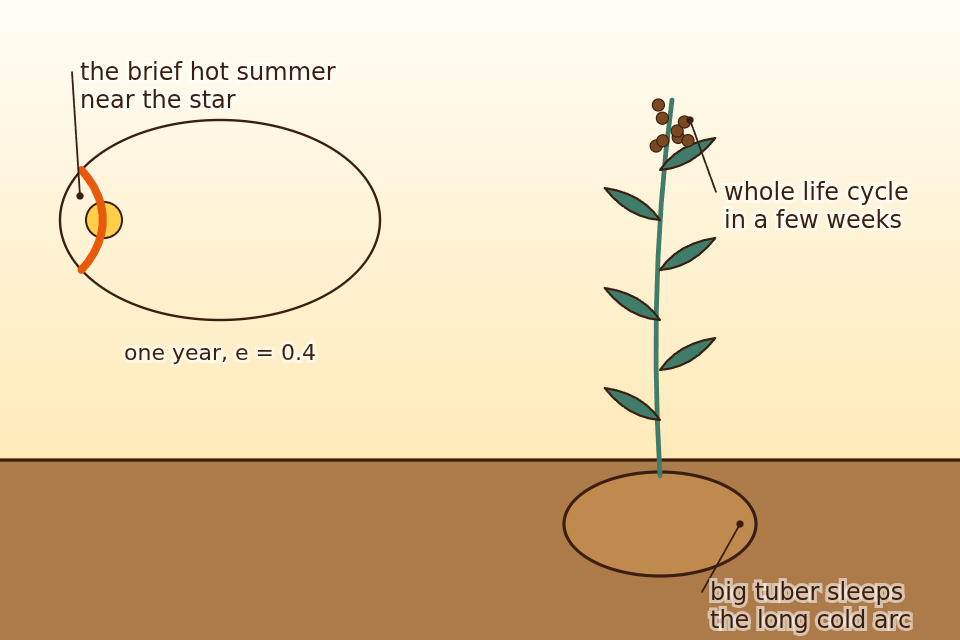
A big tuber sleeps through the long, cold part of the orbit, then sends up a stalk, flowers and seeds within weeks of closest approach. The whole planet greens and blooms at once.
For implementers: when this group switches on
- Eccentricity in the generator goes up to 0.4. The brightness ratio is ((1+e)/(1−e))²: 2.25 at e = 0.2, 5.4 at e = 0.4.
Long days and long nights
A slowly turning world has days and nights lasting many Earth days. Under thin air or strong gravity, those nights get very cold.
Night cloaks
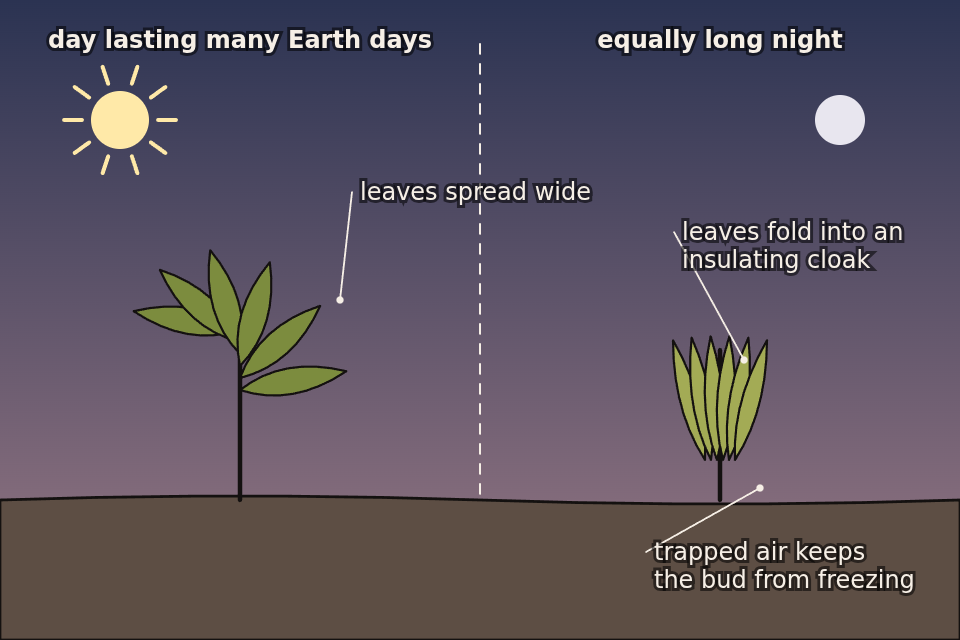
Leaves spread wide through the long day and fold up around the bud at dusk, trapping air as insulation for a night that lasts days.
Heat flasks
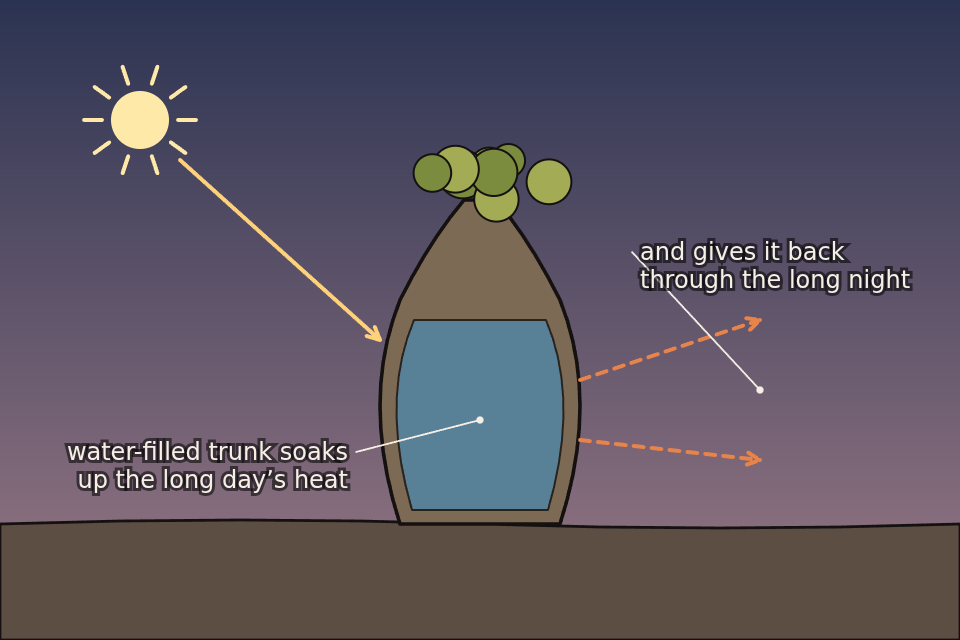
A fat trunk full of water soaks up the long day’s heat and gives it back slowly through the night, keeping the living tissue above freezing.
For implementers: when this group switches on
- How cold the night gets depends on night length compared with how fast the air column loses heat: roughly a month for Earth, three days at 0.1 bar, half as long at double gravity for the same pressure.
Short days and strong winds
A fast-spinning world gets more and stronger wind belts, with steady winds that blow from the same direction day after day.
Streamer trees
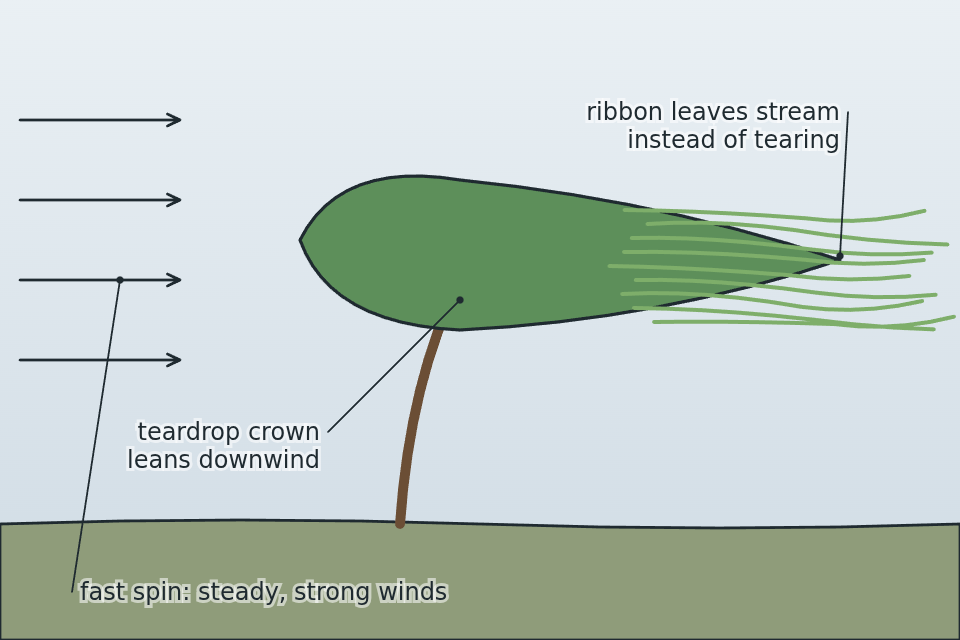
Crowns grow into streamlined teardrops that lean downwind, and the leaves are long ribbons that stream instead of tearing. Whole forests lean the same way, a compass written into the landscape.
For implementers: when this group switches on
- Rotation in the generator runs from 5 to 400 hours; faster spin adds wind cells and steadies the winds. Thick air makes any wind push harder (drag goes with air density times wind speed squared).
Plants that hunt
On Earth, carnivorous plants live where the soil is poor and catch insects to make up the difference. On a world with poor soils and plenty of slow or careless animals, plants could go after much bigger prey.
Pit traps
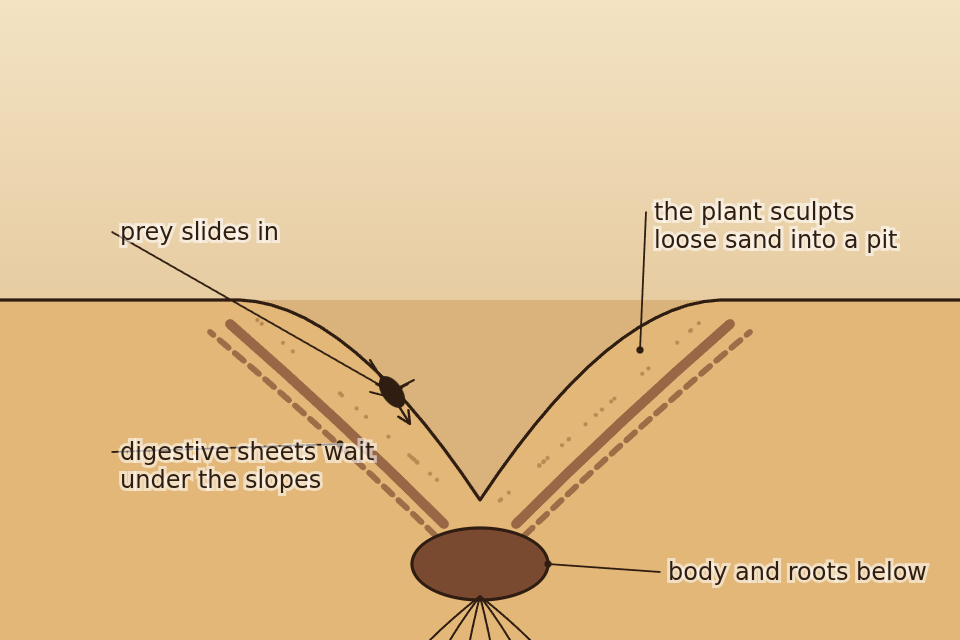
Like an antlion, the plant shapes loose sand into a steep funnel, kept at the angle where sand only just stays put, so anything that steps in slides to the bottom. Absorbent sheets lie folded just under the slopes. It doesn’t fight: it waits until the animal stops moving or starts to decay, then the sheets close over the body and digest it.
Hook-thorn trees
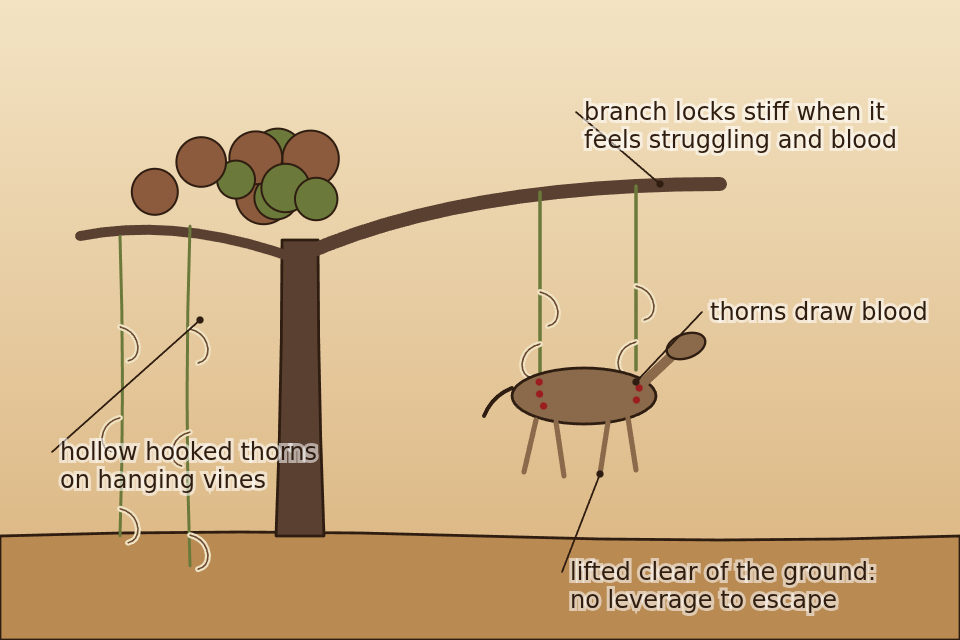
A broad tree hung with curtains of vines armed with huge, hollow, hooked thorns. An animal running through gets hooked; the tree feels the struggling and the blood on its thorns, and the branch locks stiff, lifting the animal clear of the ground where it has nothing to push against. The hollow thorns then drain it slowly, like a giant tick. Every trail through that country would bend around them.
For implementers: when this group switches on
- Poor soil (sand, leached rock, bogs) plus animals to catch. Both need animals in the world model to make full sense; until then they are rare features.
- Pit traps are small, deliberate hollows, so they have to be declared to the drainage checks rather than discovered as errors.
Borrowing from the sea
Seaweeds never needed wood, because water held them up and kept them wet. Their tricks become land tricks wherever the air does some of what water does: holds things up (thick air), carries them (drifting), or never dries out (fog). Low gravity helps all of them.
- Giant kelp, with a gas bladder on every blade, becomes air kelp on thick-air worlds.
- Bull kelp, one hollow stem with a float, becomes whip floats under low gravity.
- Sargassum, which floats on gas berries, becomes drift mats on ocean worlds.
- Coralline algae, with stone in their walls, become stone coral and crust sheets under harsh light or heavy gravity.
- Caulerpa, a single giant cell, becomes siphon giants where gravity is low and the air is damp.
- Seagrasses become ribbon meadows on sheet-flooded plains.
- Sea lettuce, a sheet two cells thick, becomes fog sheets where the air never dries.
- Phytoplankton become drift motes, if they carry gas vesicles or gravity is low.
How these fit into TerraFractal
Each habit becomes a plant family that is only switched on when the planet’s factors open its gate: air density for the balloons, gravity for the spires and carpets, eccentricity for the sinking umbrellas, day length for the night cloaks. Earth-like plants stay available everywhere, and most worlds are only mildly alien, so a typical planet gets one or two alien families and a rare one gets many. Within a planet, they’re placed by the same climate preferences as every other species.
For implementers: what has to be built
- New body parts for the generators: gas sacs and floats, bells and cups, accordion stems and caps, lattice, bottle and tube trunks, ribbon leaves, scale cones, and translucent and glowing materials.
- Plants that change over time: by season (two-form plants, retractors, migrating creepers), by orbital position (sinking umbrellas, sprinters), by time of day (night cloaks) and after weather (flash bloomers). A small state machine per species, driven by the viewer’s clock, covers all of them.
- Plants that move (migrating creepers, rolling spheres) need placement that depends on the season as well as the place, with tracks or withered trails left behind.
- Stronger, directional wind sway for balloons, air kelp, whip floats and streamer trees.
- New layers: vegetation on the ocean surface, a haze tint in the air for drift motes, a raised canopy layer for balloons, and a ground heat field for vent rings.
- Features that read from orbit: drift-mat belts along currents, ring patterns of water banks, bloom waves after storms or at closest approach, creeper bands that move with the seasons, and glow on the night side of dim worlds.
None of this is built yet. The point of writing it down first is the same as with the terrain: decide what the world is doing, then let the plants be the answer to it.